


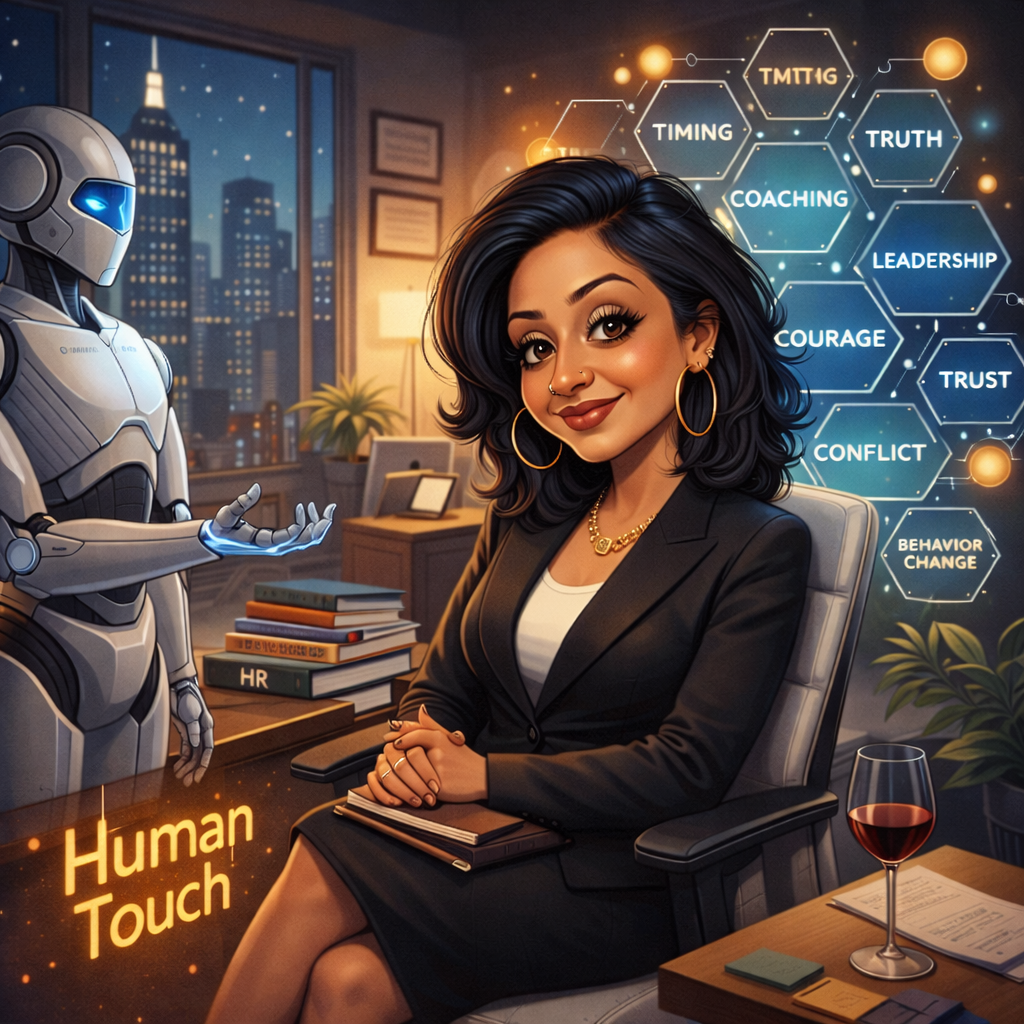
The future of HR is one of the most debated topics in business right now. Every conference keynote, every LinkedIn thought leader, every consulting firm with a slide deck is saying the same thing: artificial intelligence is coming for your job. If you work in human resources, you have probably felt the pressure, the quiet panic that maybe the robots really are about to make you irrelevant.
Here is the truth nobody is saying loudly enough: AI will not replace HR. It will replace bad HR. It will replace transactional HR. It will replace the version of HR that was never really doing the hard work. And if that scares you, this article is exactly what you need to read.
What AI Will Absolutely Replace in HR
Let us be honest about what artificial intelligence does exceptionally well. AI can draft policies faster than any HR generalist. It can analyze engagement survey data in seconds. It can generate basic performance documentation, automate onboarding workflows, manage benefits administration, and produce compliance reports without a single coffee break. These are not predictions. This is happening right now.
If the majority of your HR role involves administrative tasks, processing paperwork, copying and pasting policy language, running standard reports, or answering the same benefits questions on repeat, then yes, AI is a legitimate threat to your position. Not because AI is smarter than you. Because AI is faster at the things that never required human intelligence in the first place.
The future of HR does not belong to the person who can process the most paperwork. It belongs to the person who can do what no algorithm will ever learn to do.
What AI Cannot Replace: The Strategic HR Advantage
This is where the conversation gets real. AI can process data. It cannot read a room. AI can draft a performance improvement plan. It cannot look a struggling employee in the eye and know, based on years of human experience, whether that person needs accountability or compassion in that exact moment. AI can flag a pattern in turnover data. It cannot sit across from a senior leader and tell them that they are the reason people are leaving.
The future of HR is built on things that are fundamentally, irreplaceably human. Leadership courage coaching, the ability to develop a manager who avoids conflict into someone who leads with clarity. Conflict reality navigation: not mediating a surface-level disagreement, but identifying the power dynamics, fears, and egos driving the real issue beneath the surface. Trust rebuilding, guiding a team back from a betrayal of psychological safety that no policy manual can fix. Executive honesty development, helping a C-suite leader hear the truth about their blind spots when everyone else is too afraid to say it.
These skills require emotional intelligence, situational awareness, lived experience, and human courage. No machine learning model will replicate that. Not now. Not in ten years. Not ever. The strategic HR professional who masters these capabilities is not competing with AI. They are operating in a category that AI cannot even enter.
The Real Crisis in Organizations Is Not What You Think
Every organization claims they have a talent shortage. They say they cannot find good people. They say the labor market is broken. They say younger generations do not want to work. I have spent fifteen years in HR, and I can tell you what the real problem is: it has nothing to do with talent supply.
The real crisis in most organizations is a gap in leadership honesty and courage. Companies do not have a shortage of talented people. They have a surplus of leaders who refuse to have hard conversations, avoid accountability, and rely on HR to clean up the messes they create by avoiding them. The future of HR depends on naming this crisis out loud, because AI certainly will not do it for you.
Organizations do not need more strategy. They need leaders who will actually execute the strategy honestly. They do not need more data. They need leaders who will act on what the data is already telling them. This is not a technology problem. It is a human problem. And human problems require human solutions.
The Hidden Problem HR Has Been Covering for Years
Here is the pattern I have seen play out hundreds of times across every industry I have worked in. A leader avoids a hard conversation with a direct report. Maybe the employee is underperforming. Maybe there is a behavioral issue. Maybe the leader simply does not like conflict. Instead of addressing it directly, the leader sends it to HR. Now HR becomes the translator, repackaging the leader’s discomfort into professional language and delivering a message that was never theirs to deliver.
Then the situation escalates. HR becomes the shield, protecting the leader from the consequences of their own avoidance. Then it escalates further. HR becomes the cleanup crew, managing the termination, the exit interview, the morale damage, and the hiring of replacements that could have been avoided if one leader had simply told the truth six months earlier.
This cycle is expensive. It is exhausting. And that is why so many HR professionals burn out. The future of HR requires breaking this cycle, not by doing more administrative damage control, but by coaching leaders to handle their own truth-telling. AI can automate the paperwork that results from these failures. Only a skilled human can prevent failures from happening in the first place.
The Future HR Role: What Strategic HR Leadership Looks Like
If transactional HR is being automated, and it should be, then what does the evolved HR professional look like? The future of HR is not about compliance. It is about leadership. The next generation of HR leaders will serve as career co-architects, helping employees build meaningful professional paths that align with organizational goals rather than just filling open requisitions. They will serve as leadership behavior coaches, working directly with managers and executives to develop the interpersonal skills that actually drive retention, performance, and culture.
They will become trusted infrastructure builders, designing the systems, norms, and accountability structures that foster psychological safety at scale. And they will operate as organizational psychologists in business settings, diagnosing the behavioral root causes behind surface-level symptoms such as turnover, disengagement, and conflict.
This is not aspirational. This is already happening in the most forward-thinking organizations. Companies that understand the future of HR are investing in human-centered leadership development, not just better software. They are hiring HR leaders who can coach a VP through a difficult restructuring conversation, not just document it afterward.
The Bold Prediction: Who Will Lead the Future of HR
I am going to make a prediction, and I want you to bookmark this article so you can come back to it in five years. The highest-paid HR professionals in the next decade will not be those who mastered HRIS platforms or can recite employment law from memory. The highest-paid HR professionals will be behavior translators, people who can decode what is really happening in team dynamics and organizational culture and articulate it in language that executives can act on.
They will be leadership development architects, professionals who design and deliver programs that genuinely change how leaders show up, not just check a training compliance box. They will be truth facilitators, the rare individuals who can create environments where honest feedback flows in every direction, including upward, without retaliation or political fallout.
These are not soft skills. These are the hardest skills in any organization. And the professionals who develop them will be worth more than any AI implementation, HR tech stack, or compliance certification combined. The future of HR belongs to the professionals who choose courage over convenience, truth over templates, and human connection over algorithmic efficiency.
The Bottom Line: AI Will Handle Data, Humans Must Handle Truth
The fear narrative about AI replacing HR is understandable but misguided. AI is not the enemy of HR. Complacency is. The HR professionals who will thrive in the future are the ones who stop clinging to transactional tasks and start building the human capabilities that no technology can replicate. The future of HR is not about fighting against automation. It is about rising above it.
AI will handle the data. AI will draft the policies. AI will run the reports. But AI will never sit with a leader in their most vulnerable moment and help them find the courage to do the right thing. AI will never rebuild trust between two people who have lost it. AI will never look at an organization and see the invisible patterns of avoidance and fear that are silently destroying its culture from the inside out.
That is human work. That is HR work. And that is the future.
If you are an HR professional feeling the squeeze of AI anxiety, stop worrying about being replaced and start investing in becoming irreplaceable. If you are a leader wondering what your HR team should be focused on, the answer is not more technology. The answer is more truthful.
And if you are ready to stop surviving your career and start strategically building it, that is exactly what we do at Eunioa.
Ready to Future-Proof Your Career?
Book a free strategy call at eunioa.io and let’s build a career strategy that no algorithm can touch.
Follow Eunioa on LinkedIn for weekly insights from The Sh*t They Never Taught You newsletter.